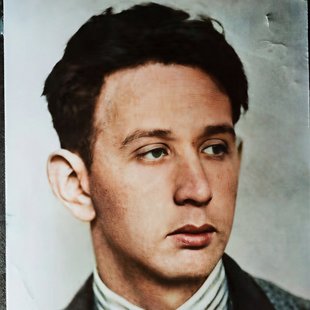
Henoch (Henryk) Barczyński
Painter and Graphic Artist, 1896–1941
Henoch Barczyński's career sits at the intersection of two major threads in early twentieth-century Jewish cultural life: the drive to build a distinctly modern Jewish art in Eastern Europe, and the destruction of that project — along with most of its participants — by the Nazi regime. He came of age artistically during a period of genuine creative ambition, co-founding the Yung-Yidish group in Łódź in 1919 alongside figures who would go on to significant careers, studying in Dresden through the Weimar years, and building a professional life in Berlin at a moment when German-Jewish cultural exchange was at its most productive. That trajectory was broken in 1933 when he joined the stream of Jewish artists and intellectuals leaving Germany. He returned to Poland and continued working, but the invasion of 1939 compressed his world further, from Łódź to Tomaszów Mazowiecki, and then to the ghetto. That he went on painting there — street scenes, portraits, the view from a window — and that he organised other artists around him, is less a story of heroic resistance than a straightforward account of a professional continuing to do his work under conditions designed to make everything impossible. He was murdered in 1941. Much of what he made did not survive. What remains, scattered across collections in Jerusalem, Tel Aviv, and Warsaw, represents a fraction of the output of a painter who spent three decades developing a serious body of work, and whose career was cut off at the point where it might reasonably have had another twenty or thirty years to run.
Henoch (Henryk) Barczyński was born on 15 December 1896 in Łódź, then part of the Russian Empire, into a working-class Jewish family. His father, Szmul Barczyński, worked as a tailor; his mother was Sara, née Parzęczewska. Despite the family's limited means, Barczyński received both a traditional Jewish education and, from 1912 to 1914, formal art training at Jakub Katsenbogen's School of Drawing and Painting in Łódź — one of the few institutions in the city offering structured instruction to Jewish students.
Around 1915–16, he moved to Warsaw to study at the school run by the sculptor Henryk Glicenstein, himself a student of Auguste Rodin and a figure of some standing in Polish-Jewish artistic circles. In 1919, Barczyński enrolled at the Academy of Fine Arts in Dresden, where he worked in the studios of Otto Gussmann and Robert Sterl. He remained in Dresden until 1926, completing a thorough academic training that ran alongside — and in tension with — his growing involvement in the avant-garde.
Yung-Yidish and the Łódź Avant-Garde
While still in the early stages of his Dresden studies, Barczyński became a founding member of the Yung-Yidish (Young Yiddish) group in Łódź in 1919. The collective brought together Jewish artists, writers, and composers who aimed to construct a distinctly modern Jewish national art, drawing on Yiddish cultural identity rather than assimilation into Polish or German mainstream culture. Other participants included the artist Jankiel Adler, the writer and theatre director Moyshe Broderzon, the sculptor Marek Szwarc, and the artist El Lissitzky.
The group published illustrated anthologies, and Barczyński contributed drawings that showed an already distinctive visual sensibility. His 1919 linocut John the Baptist — notable for using Christian iconography in a context primarily concerned with Jewish cultural renewal — illustrated the group's willingness to push against the conventions of Jewish religious respectability. The group was active until around 1921, but its influence on Barczyński's artistic thinking was lasting.
In 1918, before formally joining Yung-Yidish, Barczyński had participated in an exhibition in Białystok organised by the Artistic Section of the local Kultur-Liga, an indication that he was already connected to the wider network of Jewish cultural organisations across the region.
Barczyński's mature work is associated primarily with Expressionism, though his style shifted across different periods. Critics who reviewed his 1934 solo exhibition in Warsaw traced an evolution from early Expressionism through what they described as 'Chagallism' and post-Cézannian approaches toward a moderate post-Impressionism. Barczyński himself resisted the idea that any single movement should define an artist's output, writing in the journal Forma in 1936 that 'imposing a form on an artist is absurd.' He continued to identify Expressionism as the foundation of serious art, describing it as 'the culmination of every — with no exemption — field of art.'
The principal named influences on his work were Marc Chagall and Oskar Kokoschka. From Chagall he drew a narrative, often fantastical approach to everyday Jewish life; from Kokoschka, a commitment to emotional directness in brushwork and composition. His subject matter centred on the lives of Jewish communities in Poland: religious rituals, street figures, portraits of ordinary people, and scenes of poverty. Works such as Jew with Torah Scrolls and Pointer, Water Carrier (Nosiwoda), and Beggar in front of the Synagogue are representative of this focus.
Technically, Barczyński was versatile. He worked in watercolour, oils — including on black velour paper — copperplate engraving, and etching. He also produced graphic illustrations and propaganda poster work. In 1925, he won first prize in an International Red Cross competition for a propaganda poster, a significant professional recognition early in his career.
Europe before WWII
After completing his studies, Barczyński travelled through France, Spain, and Italy, spending time in Paris and Prague, before settling in Berlin between 1927 and 1933. During this period he participated in exhibitions in Berlin and Dresden while maintaining professional connections to Poland, regularly sending work to shows there.
In Berlin, he became associated with the circle around the German-Jewish poet Else Lasker-Schüler, a group that drew together German-Jewish intellectuals and artists working across literature, visual art, and theatre. This connection placed him within the broader context of Weimar-era Jewish cultural life in Germany, a milieu that was producing some of its most significant work even as political conditions deteriorated.
When Adolf Hitler was appointed Chancellor in January 1933, Barczyński left Germany and returned to Łódź. Press coverage of his 1934 solo exhibition at the Jewish Society for the Encouragement of Fine Arts in Warsaw — held in the Jewish community building — described the show as 'an outstanding exhibition of the German refugee.' The critic Michał Weinzieher, writing in the newspaper Nasz Przegląd, reviewed the decade of work on show as ‘a fight for the harmony of form and colour.’
From 1933 until the outbreak of war in 1939, Barczyński lived and worked in Łódź. These years appear to have been relatively stable in professional terms: he exhibited work, contributed to the cultural press, and maintained the connections to the Polish-Jewish artistic world that he had built over the previous two decades. His paintings from this period include post-Impressionist landscapes of France, one of which is now in the collection of the POLIN Museum of the History of Polish Jews in Warsaw.
In 1936 he published an essay, 'Problem współczesnej sztuki' (The Problem of Contemporary Art), in the journal Forma, in which he set out his views on the continuing relevance of Expressionism. The essay suggests an artist still actively engaged with ideas about what art was for, rather than simply producing work for market.
The German Occupation and the Tomaszów Mazowiecki Ghetto
When German forces invaded Poland in September 1939, Barczyński left Łódź as the army approached and settled in Tomaszów Mazowiecki, a smaller city approximately 100 kilometres to the south-east, where he hoped to find shelter with acquaintances. The Tomaszów Mazowiecki ghetto was formally established on 3 May 1940.
Barczyński remained active within the ghetto. He founded an Artists' Circle there, drawing in other Polish-Jewish artists, writers, and poets who had found themselves in Tomaszów. He continued to paint — portraits and scenes of daily life in the ghetto — working at the window of the apartment where he stayed.
His presence in the ghetto is documented through the letters of Lutek Orenbach, a young resident who corresponded with a friend named Edith Blau. Orenbach mentions Barczyński six times. In one passage, he describes the painter visiting and recounting his years in Madrid, Paris, Prague, and Dresden, adding: 'He's such a nice chap. Sitting by the window painting some alley of Tomaszów.' The last reference to Barczyński in Orenbach's letters is dated 25 December 1940.
Barczyński was killed in Tomaszów Mazowiecki in 1941, most likely on 14 March. Some sources record that he may have died at Auschwitz; the absence of systematic documentation of those murdered on arrival at the camp means that certainty is not possible. He was 44 years old.
Surviving Work and Legacy
A significant portion of Barczyński's output was lost or destroyed during the German occupation of Poland. Work that survived did so partly because it had been hidden — some pieces were concealed in the attic of his family home in Łódź and recovered after the war.
Surviving works are held in several major collections. The Israel Museum in Jerusalem, the Tel Aviv Museum of Art, and the Jewish Historical Institute (Żydowski Instytut Historyczny) in Warsaw all hold pieces by Barczyński. His work has been exhibited in Berlin, Dresden, Tel Aviv, New York City, and Łódź. The POLIN Museum of the History of Polish Jews holds at least one of his post-Impressionist landscapes.
Notable works in these collections include Jew with Torah Scrolls and Pointer, Water Carrier (Nosiwoda), Beggar in front of the Synagogue, Sukkot (Święto kuczek), the 1919 linocut John the Baptist, and a Cityscape from around 1930.
Scholarly attention to Barczyński's work developed gradually in the decades after the war. Yudl Sandel included him in Umgekumene Yidishe Kinstler in Poiln (Murdered Jewish Artists in Poland), published in 1957, one of the first systematic efforts to document the scope of what had been lost. Barczyński also received entries in the major reference works on Polish and Polish-Jewish art: the Słownik artystów polskich (Dictionary of Polish Artists, 1971) and the Encyclopaedia Judaica.
Jerzy Malinowski's 1987 study of the Yung-Yidish group, Grupa 'Jung Idysz' i żydowskie środowisko 'Nowej Sztuki' w Polsce, provided the most thorough contextualisation of Barczyński's early career to that point. Malinowski's later survey Malarstwo i rzeźba Żydów polskich w XIX i XX wieku (2000) placed him within the longer history of Jewish visual art in Poland.
Krzysztof Tomasz Witczak's Słownik biograficzny Żydów tomaszowskich (2010) offers the most detailed account of Barczyński's final years in Tomaszów Mazowiecki, drawing on local archival sources and incorporating a photograph and a documented list of works.
The publication of Sen o teatrze. Listy z tomaszowskiego getta (2018) — the collected letters of Lutek Orenbach — made Orenbach's references to Barczyński more widely accessible, providing one of the few first-hand accounts of a Jewish artist continuing to work under ghetto conditions.
Research by Howard Barr, a descendant of Barczyński's family, has also contributed to the documentary record, tracing family history and clarifying details of Barczyński's biography that were not captured in institutional sources.
Sources
Dorman, A. M. Autour de l'art juif. Encyclopédie universelle des peintres, sculpteurs et photographes. Chatou: [publisher], 2003, p. 24, s.v. 'Henryk Barczynski, 1896–1941.'
Kempa, Andrzej, and Marek Szukalak. The Biographical Dictionary of the Jews from Lodz. Łódź: Oficyna Bibliofilów and Fundacja Monumentum Iudaicum Lodzense, 2006, pp. 17–18. ISBN 83-87522-83-X, s.v. 'Barczyński (Barciński) Henoch (Henryk).'
Kazovsky, Hillel. 'Barcinsky (Barczinsky), Henryk.' In Encyclopaedia Judaica, 2nd ed. Detroit: Macmillan Reference USA, 2007.
Malinowski, Jerzy. Grupa 'Jung Idysz' i żydowskie środowisko 'Nowej Sztuki' w Polsce, 1918–1923. Warsaw: [publisher], 1987.
Malinowski, Jerzy. Malarstwo i rzeźba Żydów polskich w XIX i XX wieku. Warsaw: [publisher], 2000, pp. 158, 189–91.
Orenbach, Lutek. Sen o teatrze. Listy z tomaszowskiego getta. Tomaszów Mazowiecki: [publisher], 2018, p. 75.
POLIN Museum of the History of Polish Jews. Collection entry: Landscape, c. 1930. kolekcje.polin.pl/en/landscape-2 [accessed 2025].
Sandel, Józef. 'Barczyński (Barciński) Henryk (Henoch).' In Słownik artystów polskich i obcych w Polsce działających. Malarze, rzeźbiarze, graficy, vol. 1 (A–C). Wrocław–Warsaw–Kraków–Gdańsk: Ossolineum, 1971, pp. 213–14.
Sandel, Yudl. Umgekumene Yidishe Kinstler in Poiln, vol. 1. [Warsaw]: [publisher], 1957, pp. 47–53.
Witczak, Krzysztof Tomasz. Słownik biograficzny Żydów tomaszowskich. Łódź–Tomaszów Mazowiecki: Łódź University Press, 2010, pp. 32–35. ISBN 978-83-7525-358-0.
Yiddishkayt. 'Henekh Barczyński.' yiddishkayt.org/view/barczynski/ [accessed 2025].