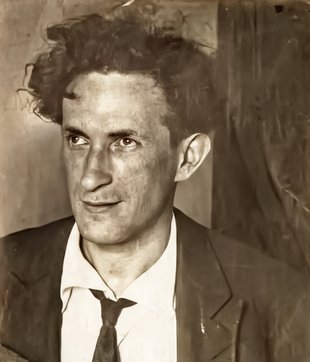
Oser Warszawski
Writer, Painter and Witness
Oser Warszawski was a Yiddish novelist, painter, and art critic who spent the years between the two world wars at the centre of Jewish avant-garde literary and artistic life in Paris. When Germany occupied France in 1940, he remained in Paris and began documenting what he saw. Over the following four years he moved progressively further from safety — south through Vichy France, into Italian-occupied territory, and finally to Rome — writing and drawing throughout. He was arrested there in May 1944, days before the city was liberated, deported to Auschwitz, and killed in October of that year. His wartime manuscripts survived and were published after the war by his widow. He is among a very small number of writers who produced sustained literary work describing the persecution of Jews while directly experiencing it.
Oser Warszawski — also known as Oyzer Varshavski — was born on 15 April 1898 in Sochaczew, in the Warsaw area of Congress Poland. His father Gadalya was a follower of the Jewish Enlightenment who had lived for a time in London; his mother's name was Rivka. The family moved to Warsaw when Oser was fourteen. He received a traditional Jewish education, worked briefly as a Hebrew teacher, and then mastered photography, working as a travelling photographer during the First World War before turning to writing in Yiddish. He was encouraged in this by the naturalistic novelist Itshe-Meyer Vaysenberg, who later published his debut novel.
That novel, Shmuglars (Smugglers), appeared in 1920 and established his reputation immediately. Set during the German occupation of Poland in the First World War, it follows Jewish smugglers and other underworld figures in a Polish town, depicting how Jews survived by distilling illegal liquor and moving contraband while avoiding detection by Polish Christians, the police, and the German occupiers. The critic Shmuel Niger described the prose as "fresh and moist, like a section of a field about to be ploughed," and the novel was understood both as a work of social realism and as a piece of avant-garde Yiddish literature. It crossed linguistic borders as rapidly as its characters crossed physical ones: it went through five Yiddish editions, three Russian editions, and one Hebrew edition within a decade, and sold an estimated one million copies in total. An English translation by Golda Werman appeared in 2008, and a French translation as Les Contrebandiers in 1989. Warszawski completed two further novels treating Jewish life in the First World War — the second set in a Polish village, the third in Berlin — known collectively in French as La Grande Fauchaison (The Great Reaping).
In 1922 Warszawski was part of the avant-garde Yiddish movement Khalyastre (The Gang), alongside Peretz Markish, Uri-Tsvi Grinberg, Melekh Ravitsh, and Yisroel-Yehoshue Zinger. In 1923, due to a problem with his documents, he left Poland, spent time in Berlin and briefly in London, and in 1924 settled in Paris.
Montparnasse: painting, criticism, and the artists' colony
Warszawski developed as a visual artist in Paris. After arriving in Montparnasse, he took up painting and became an active member of the artistic community centred on the neighbourhood — a milieu that, at that time, included Chagall, Soutine, Modigliani, Krémègne and many others from the Eastern European Jewish diaspora. Unlike many of his contemporaries, who had undergone formal training before arriving in Paris, Warszawski developed his artistic practice there from the mid-1920s onwards, alongside his writing and criticism.
He co-edited the second issue of the Khalyastre journal with Markish, with cover art and contributions by Marc Chagall. He wrote monographs on two of the painters he knew there: one on Pinkhes Krémègne in 1928, and one on Marc Chagall, published in 1926 in the Parisian Revue Littéraire, with the characteristically precise subtitle "the shtetl and the magician." He also published a monograph on the painter Abraham Manyevitsh in 1930, with a foreword by the Soviet cultural commissar Anatoly Lunacharsky.
His most substantial contribution as a visual artist was L'Arrière-Montparnasse (Behind Montparnasse), written and illustrated during the 1930s. The book turned its attention away from the celebrated figures of the colony and towards its less visible inhabitants — the struggling, marginal, and overlooked — and was illustrated throughout with his own watercolours, gouaches, and sketches. The work operates simultaneously as a visual record and a piece of social portraiture of a world that was itself about to be destroyed. Among the surviving works, the Musée d'art et d'histoire du Judaïsme in Paris holds a collection of his sketches and paintings including four self-portraits, as well as at least one watercolour of the Montparnasse scene: Le peintre Petroff levant son verre (The painter Petroff raising his glass), a characteristic example of his focus on the daily social life of the artists around him.
During his years in Montparnasse, Warszawski also befriended the painter Léon Weissberg and his wife Marie. He began a relationship with Marie Weissberg in 1932, and she would eventually become his wife.
His second novel, Shnit-tsayt (Harvest Time), published in 1928, was poorly received by both critics and readers, and the disappointment appears to have affected him deeply. Contemporaries noted a significant falling-off in his literary output during the 1930s. The Yiddish writer Y. Botoshanski wrote that no writer among his acquaintance had descended so far "to the spiritual nadir" as Warszawski had, suggesting that he had glimpsed an artistic abyss and failed to move beyond it. Through the 1930s he contributed technical editorial work to the Yiddish encyclopaedia Algemeyne entsiklopedye, proofread for the printing house Jacques London, and wrote stories that were never published in his lifetime. He was often in the company of Peretz Markish and Ilya Ehrenburg during their visits to Paris. It was in the visual arts, and in the company of the Montparnasse painters, that he found most satisfaction during these years.
Occupation and flight
In 1939 he enlisted as a volunteer in the Polish army. With the outbreak of war, he was seized by what contemporaries described as a kind of feverish urgency: filled with a premonition that catastrophic events were coming, particularly for Jews, he began systematically noting, registering, and recording everything he witnessed. When the Germans occupied Paris in 1940 he chose to remain, continuing to frequent café terraces and writing several texts on the fall of France.
In 1941, having witnessed the first roundups of Jews, he began writing Rezidentsn, subtitled On ne peut pas se plaindre (One can't complain). The work follows several Jewish characters moving through occupied France and introduces a persona named Naphtali Cheminere — combining a Hebrew word associated with combat with a French word meaning to be on the road — a figure Warszawski used to embody the contemporary version of the Wandering Jew. The language of the narrative is quasi-conspiratorial, full of allusions and euphemisms, while the protagonist's thoughts foreshadow collective death.
In May 1942 Warszawski left Paris for Marseille, where he spent time attempting to find a way to emigrate to a country outside Europe. When that proved impossible, he obtained papers to visit Marie, who was under house arrest in Rodez in the Aveyron, and married her officially. He then moved to Gordes in Provence, where Marc Chagall had left him the keys to his house before leaving for America with his wife Bella the previous spring, assisted by Varian Fry and the Emergency Rescue Committee. The proximity between the two men is worth noting: the Chagalls were able to emigrate to safety; the Warszawskis were not. The Vichy authorities placed Warszawski under house arrest in Gordes. For a period in 1942 he was also in Nice.
In June 1943, following roundups in the south of France, he and Marie fled via Grenoble to Saint-Gervais-les-Bains in Savoie, then under Italian occupation. In September 1943, following the Italian armistice with the Allies, he left with the retreating Italian army and the couple reached Rome, where they were required to register with the authorities, including listing their address. In Rome, Warszawski kept a journal, wrote short stories in Yiddish, and continued working on accounts of the period, spending part of this time in hiding and part, according to some accounts, in a Rome prison.
On 17 May 1944 — two weeks before Allied forces entered Rome on 4 June — he was arrested by the Italian police and handed over to the Germans. According to testimony later given by a survivor, Aba Furmanski, at the Oswego refugee camp in the United States, it was the Gestapo who seized him. He was transported on 20 May to a camp in Modena, then deported to Auschwitz. He was murdered there on 10 October 1944, aged forty-six. Marie was not on the arrest list and survived. Fragments published in the Paris Yiddish press after the war indicate that he was still writing in his final months. His diary from the months in Italy has not been published.
After the liberation of France, Marie worked to preserve his manuscripts and published his wartime writings in both Yiddish and French translation. Rezidentsn appeared in the Parizer tsaytshrift in 1955. Shmuglars was reissued in a new edition in 1969. L'Arrière-Montparnasse was published by Lachenal & Ritter in 1982. A collection of three stories — Les Contrebandiers, La Fauchaison, and L'Uniforme — appeared in French translation in 2007. An exhibition catalogue, L'éclat des crépuscules, was published in Paris in 1998 to accompany a retrospective held at the Medem Library in the Paris Yiddish Center. Marie's daughter by her first marriage, Lydie Lachenal, continued the work of preservation after her mother's death. A memorial to Warszawski was erected at Marie's graveside in the Montparnasse cemetery.
Sources
Niborski, Yitskhok (trans. Yankl Salant). "Varshavski, Oyzer." YIVO Encyclopedia of Jews in Eastern Europe. encyclopedia.yivo.org/article/1158
"Varshavski, Oyzer." Biographical Dictionary of Modern Yiddish Literature (Leksikon fun der Nayer Yidisher Literatur), vol. 3. New York: Marstin Press, 1960, p. 317. Available via: congressforjewishculture.org/people/4714/oyzer-varshavski
"Warszawski, Oser." Encyclopaedia Judaica. © 2007 The Gale Group. Available via: www.encyclopedia.com/religion/encyclopedias-almanacs-transcripts-and-maps/warszawski-oser
"Ozer Warszawski." Yiddishkayt. yiddishkayt.org/view/ozer-warszawski/
"Ozer Warszawski." arunsolwarszawski (family/memorial blog), 26 June 2016. arunsolwarszawski.wordpress.com/2016/06/26/ozer-warszawski/
"Warszawski, Oser." Jewish Virtual Library. www.jewishvirtuallibrary.org/warszawski-oser
Sonn, Richard D. "On the Road: Jewish Artists in Vichy France." The Journal of the Western Society for French History, vol. 51, no. 2 (2025), pp. 3–13. doi.org/10.3998/wsfh.7319
Boyer, Irène and Gilles Rozier, eds. L'éclat des crépuscules: Oser Warszawski, 1898–1944; Un écrivain yiddish entre chien et loup / Oyzer Varshavski: A yidisher shrayber in likht fun beyn-hashmoshes. Paris, 1998. Exhibition catalogue.
Warszawski, Oser. L'Arrière-Montparnasse. Lachenal & Ritter, 1982.