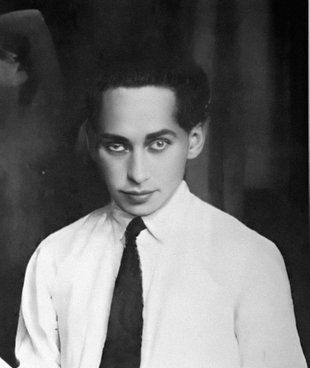
Ernest Neuschul
(1895–1968)
Ernest Neuschul was a painter and graphic artist whose career in Germany was cut short by the Nazis and who spent the rest of his life in exile. He was born on 17 May 1895 in Aussig, a town on the river Elbe then part of Austria-Hungary and now Ústí nad Labem in the Czech Republic. His family was Jewish and respected in the town: he was the eldest of three sons of Josef Neuschul, an ironmonger, and his wife Jeanette, née Feldmann. Though his parents disapproved of his ambitions, he trained as an artist in Prague, Vienna and Kraków, where he studied under the Jugendstil painter Józef Mehoffer. In Vienna he absorbed the work of Gustav Klimt, Egon Schiele and Oskar Kokoschka, and his early paintings were strongly Expressionist.
The First World War shaped him early. A pacifist determined not to fight, Neuschul avoided conscription and moved to Kraków in 1916, staying there until the war ended. His son Khalil Norland later described the lengths he went to in order to stay out of the army, starving himself before medical boards and feigning epilepsy to appear unfit. He graduated in 1919 and held his first solo exhibition in Prague that year.
In August 1918, in Prague, he met the Dutch-Javanese dancer Lucie Lindermann, who performed as Takka-Takka, and the two married in 1922. She became his first main model. He designed her costumes, studied Indian dance and wrote screenplays on Asian themes, and from 1922 the couple toured as a Javanese dance act under the name Yoga-Taro, with a programme called "Asiatische Phantasien." They performed across Europe and in the USA and Canada, appearing in cities including New York and Montreal, before the partnership ended in 1926 and Neuschul returned to painting full time in Berlin.
Neuschul became one of the leading figures of the New Objectivity (Neue Sachlichkeit) movement, which reacted against Expressionism in favour of a harder, more direct realism. He joined the anti-fascist Novembergruppe in 1926 and later chaired it. Through the group he was mentored by the Jewish artist Arthur Segal in Expressionist composition and became friends with Ludwig Meidner, whose emotional, often religious figure paintings left a mark on his work. A committed socialist and member of the Communist Party, he used painting to record the lives of working people: industrial labourers, unemployed men, marginalised women, Black people and the travelling community, as well as the figures of Berlin's cabarets and nightlife. His son described the impulse behind the work as a drive to create "starkly drawn confrontations with reality." Unlike some others in the movement, his socially critical paintings carried a clear sympathy for their subjects, treating them with a dignity that itself amounted to a political statement.
His reputation broke through in 1927, when he showed in around eight exhibitions, six of them in Berlin, and signed a contract with the Neumann-Nierendorf Gallery that gave him a steady income. His teaching career followed: he was appointed to the chair of drawing and painting at the Charlottenburg Municipal Art School in 1931 and became Professor of Fine Art at the Berlin Academy of Fine Art in 1932. In the same year he painted "Der Agitator" (The Agitator), a self-portrait that presents him as an anti-fascist fighter on the eve of Hitler's Germany.
Neuschul's finished paintings look like direct observation, but he built them indirectly. He carried a Leica camera and took photographs of people in everyday surroundings, often without their knowledge, while also making sketches from life. Back in the studio he would select the photographs that struck him and compose a new picture from them, working without a live model. This method let him assemble scenes that made a point rather than simply recording one.
His painting Black Mother (1929–31) shows how this worked and how his art commented on the society around him. It depicts a Black woman on a park bench in Berlin, fashionably dressed in a cloche hat, breastfeeding her child and looking directly out at the viewer. Work-in-progress photographs kept by his son show that Neuschul changed the composition as he painted, including turning the mother's gaze to meet the viewer's. As his son put it, this made "a strong ideological point": mother and child appear startled by an intruder, yet proud and defiant. Posing a modern Black mother in the manner of a traditional "Madonna Lactans" was a deliberate provocation against the racial and eugenicist ideas of motherhood promoted by the German Right. The subject was pointed for another reason: Black people in Germany were persecuted under the Third Reich, and the painting insists on the dignity and presence of people the regime sought to erase.
That commentary has proved durable. In 2022 the National Gallery paired Black Mother with Titian's late The Virgin Suckling the Infant Christ, presenting Neuschul's picture as a Black Madonna and using the juxtaposition to raise present-day questions about race, identity and belonging. Leicester Museums, which holds the work, has used it to mark Black History Month, International Women's Day and debates about breastfeeding in public, and audiences continue to read the mother's expression in opposite ways, as fear or as pride. The picture Neuschul designed to unsettle a 1931 audience still does similar work today.
Neuschul's standing collapsed when the Nazis came to power. Because of his Jewish background and his radical politics, he lost his teaching post and was labelled a "degenerate artist." His last Berlin exhibition, in February 1933, was shut down; works were confiscated and many destroyed, including a family group painting related to Black Mother that survives only as a photograph. Neuschul said the Nazis particularly hated his family portraits. The scale of these losses is one reason he is less well known today than his earlier prominence would suggest. He left Germany for his home town of Aussig, accompanied by the painter Christl Blell, who became his second wife.
In 1935 the Moscow Artists Association invited him to the Soviet Union, and he travelled there in September with around forty works. He painted portraits of steelworkers and revolutionary figures and received a commission for a double portrait of Stalin and the Bulgarian Communist Georgi Dimitrov, a canvas later cut in two when Dimitrov fell out of favour. But he was pressed to abandon his socially critical style and paint workers in the idealised manner of Socialist Realism, which he refused to do. Warned by the education commissar Andrei Bubnov that it was no longer safe to stay, he left as Stalin's purges intensified, which also spared him the anti-Jewish element of those purges, and returned to Aussig. (Sources disagree on the year: the German-language accounts give 1937, while several English-language accounts, including Ben Uri, give 1936.) Antisemitism was rising at home too: in 1937 two of his paintings on show in Aussig were slashed and disfigured overnight with swastikas, a clear warning of what lay ahead.
The family moved to Prague, where Neuschul kept working, completing three portraits of President Edvard Beneš and giving lectures. As both a Jew and a "degenerate artist," he was in danger on grounds of race, politics and art alike. With help from a senior member of the German Social Democratic Party, and a visa obtained through the Welsh MP David Rhys Grenfell, he escaped with his wife and son on the last train the Nazis allowed out of Czechoslovakia, on 24 March 1939, reaching Britain just days before war was declared. He carried Black Mother with him as one of his most valued possessions; it is now among the few of his pre-war paintings that survive. His mother and other relatives who remained behind were murdered in the Holocaust.
His route to safety ran through Welsh politics. Grenfell, the Labour MP for Gower, had gone to Prague in 1939 on behalf of the Labour Party to help evacuate people most at risk, having already organised similar rescues during the Spanish Civil War. He was a former coal miner from Gorseinon who had taught himself several languages, including German, and it was through his intervention that Neuschul and his family reached Britain and, eventually, Swansea.
After moving between London, Devon and Oxford, the family settled at Grenfell's suggestion in Mumbles, near Swansea. They first lodged with Grenfell's brother Mansel in a large house in Langland; when the army requisitioned it, they moved to Brooklyn Terrace, and Neuschul's son Peter attended the nearby Oystermouth school. In a 1940 radio interview, Christl Neuschul said the family had met nothing but kindness from local people.
Neuschul kept painting throughout the war, applying the same eye for working people to his new surroundings. His subjects were the steelworkers, miners and cockle pickers of the Gower coast. He also painted local figures, including the Mayor of Swansea, J. R. Martin, and Lewis Jones MP. In gratitude to Grenfell he painted two portraits of him, one now in the Glynn Vivian Art Gallery and the other in the Gorseinon Institute. William Grant Murray, curator of the Glynn Vivian, arranged an exhibition of thirty-seven of his paintings. In 1940 Neuschul donated his painting Cocklewoman to the gallery, inscribing it in gratitude to the people of Swansea for sheltering a refugee from Nazi oppression.
His wartime activity extended beyond painting. He exhibited with the Free German League of Culture at the Wertheim Gallery in London in 1939, lectured for the Anglo-Sudeten Club and contributed articles to its newspaper between 1942 and 1945, and gave talks about art on the radio. In March and June 1941 he submitted work to the War Artists Advisory Committee, on Grant Murray's recommendation among others, but was not selected. In 1944 his paintings were shown at the National Museum of Wales.
Once the war ended, Neuschul concluded that Swansea could not support him as an artist and moved to London in 1946, settling in Hampstead and anglicising his name to Ernest Norland. Despite a solo exhibition at the Twenty Brook Street Gallery in 1950, he never regained his earlier success and remained largely forgotten in both Britain and Germany. Retrospectives were held at the Betzalel (Bezalel) National Museum in Jerusalem in 1959 and in Berlin in 1966, the latter titled "From the New Objectivity to the New Non-Objectivity." His late work moved towards simplified figuration and, in the end, full abstraction. He died in London on 11 September 1968, the same year as Grenfell.
His first UK retrospective came posthumously, at Leicester Museum & Art Gallery in 1988. In 2002 he was rediscovered in Germany through an exhibition of his New Objectivity work at the Kunstforum Ostdeutsche Galerie in Regensburg, mounted with a Czech partner institution. His work is now held in UK collections including the Ben Uri Collection, the Glynn Vivian Art Gallery in Swansea and Leicester Museum & Art Gallery, as well as public collections in Germany, the Czech Republic and Russia.
Sources
Ben Uri Gallery and Museum. "Ernest Neuschul: Biography." benuri.org/artists/726-ernest-neuschul/biography/
Ben Uri Research Unit. "Ernst Neuschul." www.buru.org.uk/contributor/ernst-neuschul
German Expressionism Leicester. "Ernst Neuschul." www.germanexpressionismleicester.org/leicesters-collection/artists-and-artworks/ernst-neuschul/
German Expressionism Leicester. "In Search of the Black Mother." germanexpressionismleicester.org/leicesters-collection/academic-reports/academic-essays/in-search-of-the-black-mother/
Leicester Museums & Galleries. "The Neuschul Gift." www.leicestermuseums.org/news/the-neuschul-gift/
Jewish Museum Berlin. "Ernest Neuschul: Samson II." www.jmberlin.de/en/ernest-neuschul-samson-II
Lepine, Ayla, and Mark A. Simmons. "Love." In Fruits of the Spirit: Art from the Heart, ed. Susanna Avery-Quash and Ayla Lepine. London: The National Gallery, 2022. www.nationalgallery.org.uk/research/publications/exhibition-catalogues/fruits-of-the-spirit-art-from-the-heart/love
Gwallter. "A Czech Refugee Artist in Mumbles." gwallter.com/books/a-czech-refugee-artist-in-mumbles.html
Insiders/Outsiders Festival. "Tribute to Ernst Neuschul" (talk by Simon Lake). insidersoutsidersfestival.org/event/tribute-to-ernst-neuschul/
Kunstforum Ostdeutsche Galerie, Regensburg. "Ernest Neuschul" (2002 exhibition). www.germangalleries.com/Kunstforum_Ostdeutsche_Galerie/Neuschul.02.html
"Ernest Neuschul." German Wikipedia. de.wikipedia.org/wiki/Ernest_Neuschul
West Glamorgan Archive Service. "Papers of D. R. Grenfell, MP for Gower," ref. GB 0216 D 207/6/1. www.swansea.gov.uk/article/998/West-Glamorgan-Archive-Service