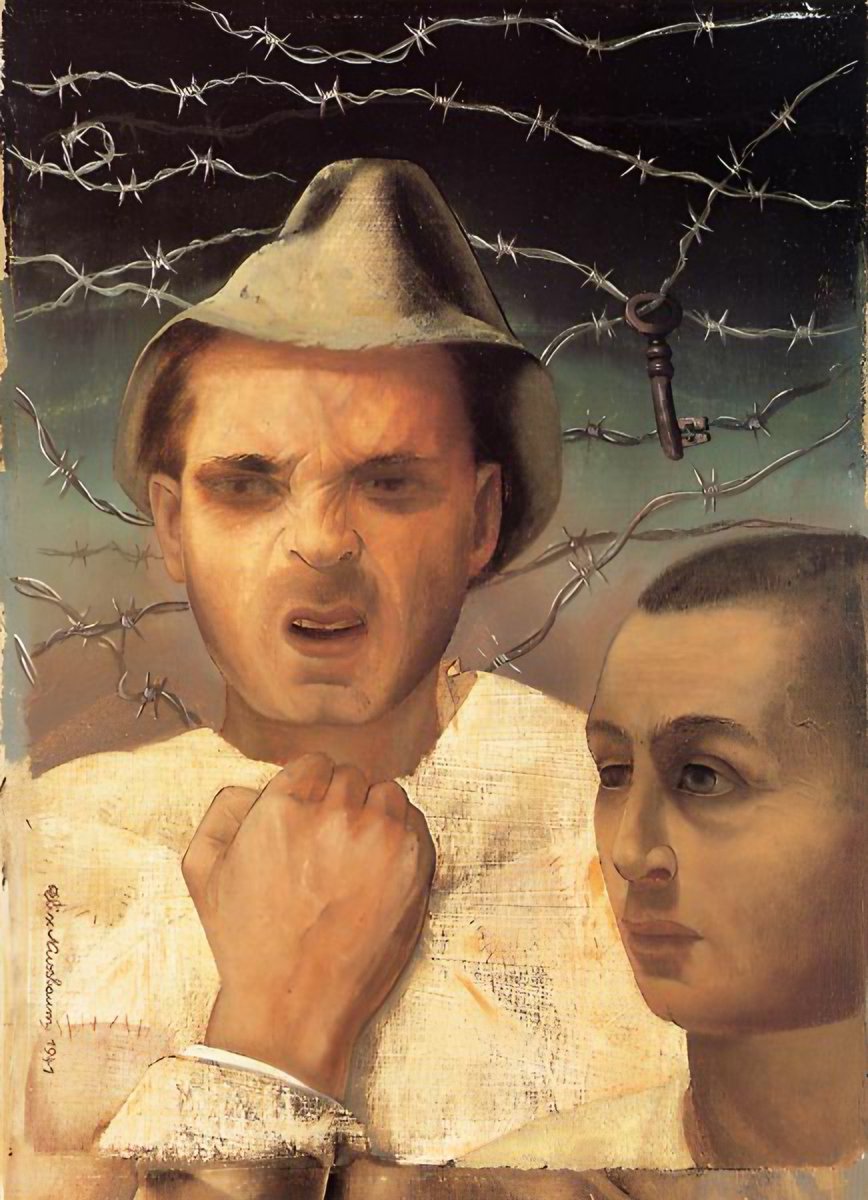
Felix Nussbaum
Felix Nussbaum painted his strongest work while he was being hunted down. Before 1933 he was a rising name among the younger painters of Berlin; after the Nazis took power he never went home, and he spent the last nine years of his life as a refugee in Belgium, with no work permit, no reliable income, no audience, and for the final four years no legal right to be there at all.2, 3, 4 Those were the years in which he became a major artist.2, 3 Working first in a studio he could reach only by crossing occupied Brussels, and then in a basement he could barely leave, he made his own predicament his subject and set it down as it happened: internment in a French camp, enforced idleness, the identity card on which his nationality was entered as "without", the yellow star, the wait for a knock at the door. He dated the pictures like diary entries.4 He was not looking back at events; he was painting the month he was living through, in the growing certainty that he would not outlive it. "If I perish — do not let my paintings die," he said.4 He was right about his own chances and wrong about the paintings. Around 200 of them survive.4
Osnabrück and Berlin
Nussbaum was born in Osnabrück on 11 December 1904, the second son of Philipp Nussbaum and his wife Rahel.1, 4 His father ran a hardware business in the town with his cousin Simon Gossels, had served in the First World War, and had wanted to be a professional painter in his youth before financial pressure pushed him into trade.1, 4 He encouraged his son's ambition to study painting.1, 4 The family lived in a villa on Schloßstraße, belonged to the Reform Jewish community rather than an observant one, and holidayed on Norderney and at Ostend — the same Belgian resort where Nussbaum would later live as a refugee.4
He began his studies in Hamburg in 1922 and moved to Berlin the following year, studying under Cesar Klein and, from 1928, as a master student of Hans Meid.4 He had his first solo exhibition at the Casper Gallery on Hallesches Ufer at the age of twenty-three, rented his own studio on Xantener Straße in 1929, and was a recognised name among the younger Berlin artists by 1931.4 The early work shows van Gogh's influence, inherited from his father's taste, and then Henri Rousseau, Giorgio de Chirico and Carl Hofer as he moved away from it.1, 4 In 1932 he went to Rome as a guest student at the German Academy in the Villa Massimo.3, 4 He had gone reluctantly — "I'm sure I'll end up kitschy down there" — and painted old walls and abandoned farms rather than the picturesque south.4
1933: the end of a German career
Nussbaum was in Rome when he learned that the Nazis had taken power.3, 4 In April 1933 Joseph Goebbels visited the German artists in the city and set out the regime's artistic doctrine: the Aryan race and heroism were to be the Nazi artist's subjects.1, 2 Nussbaum understood that there was no place in it for him, left Rome by early May, and had his scholarship withdrawn shortly afterwards.2
His parents left Osnabrück, as many of the town's Jews did. His elder brother Justus stayed to run the family metal business.2 Philipp and Rahel spent a short period in Switzerland and then travelled south to Rapallo on the Italian Riviera, where the family spent the summer of 1934 together; the paintings of that summer, such as The Beach at Rapallo, are unusually light in mood.2, 4 It was the last time Nussbaum saw his parents.2, 4
In 1935 they decided to go home to Germany, against his objections.1, 2 His father had written a parting poem to his comrades from the veterans' association ending with a promise that if called to the flag again he was ready and willing; Nussbaum rewrote the last line to read that he would desert to a far-off place instead.2 It was, according to the Yad Vashem account, the only occasion on which he contradicted his father, who was also the source of his financial and moral support.2 Two gouaches of this period read as commentary on the decision: in Cemetery Bench an elderly couple sits mourning, and in The Sick Rider a rider goes forward without looking, straight into the arms of death.4
Ostend and Brussels, 1935–1939
Nussbaum and Felka Platek — born in Warsaw in 1899, trained in Berlin under Ludwig Meidner, and a companion since the mid-1920s — went first to Paris in January 1935 and then to Ostend on tourist visas.2, 4 He described the period in a Belgian newspaper interview in February 1939: "The ongoing search for tranquillity and a new homeland took up all my time. Never at home, I moved around with hastily made watercolours rolled up in my pack... Switzerland, France, Paris..., until the border to Belgium finally opened itself to my relief. In Ostend I started working again, drew and painted a lot. I am resisting and I will not tire. It's ok."3
The reality was applications for residence permits, repeated changes of lodging, and no recognition for the work.4 His self-portraits track it precisely. In Self-Portrait with Tea Towel (1936) he poses bare-chested against the dark roofline of Ostend with a German kitchen cloth knotted around his shoulders — a scrap of domestic Germany, and also, draped that way, something like a prayer shawl. The Nuremberg Laws had been passed the year before.4 The harbour and street scenes of these years grow steadily darker and emptier, and objects in them begin to carry menace: the looming bollard of Krakenbollard, the lurking figure of Fish Woman in the Harbour.4 Forest of Masts, painted in Brussels as a farewell to Ostend, turns the interlocking masts into something closer to artists' tools, a picture of pointless waiting and of working against a headwind.4
The couple moved to Brussels in September 1937 and married there in October.2, 4 Nussbaum became friendly with the Belgian sculptor Dolf Ledel, who helped him find a few exhibition opportunities.4 In 1938 he was to show in the Free German Art exhibition in Paris, mounted as an answer to the Nazi Degenerate Art exhibition in Munich that year; his two contributions — The Pearls and a still life with a barred window — were political statements against war and against the ban on his working, and they never went on the wall, having been held up by customs.4 He produced no further explicitly political pictures.4
What he produced instead was a series of pictures about being an artist who cannot work. Self-Portrait in the Studio (c. 1938) can be read as the portrait of an emigrant forbidden to practise his profession and as a statement about his own stalled position.4 Painter and Model (c. 1938–39) was sent to his father in Amsterdam as a kind of progress report.4 For a short time he tried out the surrealist manner then fashionable in Belgium — "not without wit", his friend Fritz Steinfeld recalled — and in Self-Portrait in a Surreal Landscape and Surreal Landscape with Organ Grinder used borrowed formal means to picture his own disorientation.4 The organ grinder, faceless and standing in shadow, is the first appearance of a figure he would use repeatedly as a stand-in for himself as an artist.4
Meanwhile the family scattered further. Justus was forced out of the Osnabrück business when Jewish firms in the town were expropriated, and fled with his wife Herta and their two-year-old daughter Marianne to the Netherlands on 2 July 1937, where he set up a scrap-metal company with other refugees.2 On Kristallnacht the Osnabrück synagogue was burned, Jewish homes were looted and the town's Jewish men were sent to Dachau.2 In May 1939 Philipp and Rahel Nussbaum left Germany for Amsterdam to join their elder son.2
The Great Disaster and The Refugee
Two paintings of 1939 show how clearly Nussbaum had understood where things were going. The Great Disaster treats Hitler's accession as the destruction of Europe and of European civilisation.2 European Vision – The Refugee is more specific: a man sits at a table with his head in his hands, a globe standing on the table in front of him. The door of the room is wide open and offers nothing. Outside there is a tree shedding its leaves and ravens circling a body. There is nowhere on the globe for him to go.2
At the outbreak of war Nussbaum was in the position of belonging nowhere — an unwelcome foreigner in Belgium, a persecuted Jew in Germany.4 In Self-Portrait with Scabious he presents himself as an unmilitary German holding out not a rifle but the blue flower of Romantic art and imagination.4 From here his painting takes on the character of a diary of political events.4 In early 1940 he made a series of still lifes in which ordinary objects stand in for his circumstances; in Tombola the arrangement is deliberately random and meaningless, a picture of a world he could not read.4 La nature morte (Still Life with Pomelo) includes a scrap of the newspaper Le Soir dated 16 April 1940.4
Saint-Cyprien
German forces invaded Belgium on 10 May 1940.6 Nussbaum was arrested at his apartment the same day, along with other German nationals, and after several days in a boarded-up cattle wagon was interned at Saint-Cyprien in the French Pyrenees.2, 4, 6 The Osnabrück museum's account of the period calls the camp the "Pyrenean hell"; the closeness of death from disease and the conditions in the camp produced in him the fear that "they would all be killed".4
Saint-Cyprien changed the subject matter of his work. The Camp Synagogue at Saint-Cyprien (1941) was his first painting on a Jewish theme in many years, and the Yad Vashem account reads it as the point at which he recognised that he belonged to the Jewish people and was so classified by others whether he liked it or not.2 He had made his Jewishness the subject of a painting once before, as a twenty-one-year-old, in The Two Jews (1926), set in the interior of the Osnabrück synagogue, but had had no wish to be seen as a "Jewish painter" and had largely left the theme alone.4
In August 1940, after three months in the camp, he signed a document from the French camp administration requesting "repatriation to the Reich".2, 4 At a stop at a barracks in Bordeaux he escaped, in the company of a school friend from Osnabrück, and made his way back to Brussels and to Platek.2, 4
In hiding
From 1940 he lived without papers and without any legal means of earning money. Belgian friends met his needs and provided him with a studio and materials, and he moved between his hiding place and his studio, working continuously.1, 2 The subjects were fear, persecution and the danger hanging over his family.2
German legislation in occupied Belgium closed in around him. The decree requiring Jews to wear the star, at the end of May 1942, completed the anti-Jewish legislation there, and deportations from Belgium to the extermination camps in the east began in August 1942.4 Nussbaum came to see the camp not as a past episode but as a description of his present: occupied Belgium was itself the camp.4
When he abandoned his studio in the autumn of 1942 he left three large paintings behind, and together they set out the only two options he could see — flight or endurance.4
Saint-Cyprien (1942) reworks a drawing made immediately after his escape into an allegory built on the four sons of the Passover Haggadah — the wicked one, the wise one, the simple one and the one who does not know how to ask. Nussbaum himself holds a walking stick and a bundle and appears ready to leave; a globe wrapped in barbed wire in the same picture indicates where he would be going.4 Soir shows him and Platek in an awkward embrace: he is half-dressed and apparently ready to run, while she stands on his left foot.4 In The Organ Man the question has been settled. The organ grinder has stopped playing, the crank is gone, the pipes have turned to bone, and behind him is general ruin. He looks out of the picture without expression. It is too late to leave.4
The couple stayed with the Ledel family from autumn 1942 until March 1943. When the Ledels decided to escape to the Ardennes they offered to take the Nussbaums with them; Platek no longer had the strength for it and chose to stay in Brussels, and Nussbaum would not leave her, so the two returned to their apartment at 22 rue Archimède.4, 6 Their landlord had fitted out a concealed attic room in the building so that an empty apartment could always be shown to a Gestapo search party.4, 6 During these months of moving between attic and apartment they made only pencil drawings and gouaches, carefully dated like diary entries; oils were impossible because the smell of turpentine would have given them away.4
The last paintings
In May or June 1943 Nussbaum took a basement studio in the rue Général Gatry, and the final paintings were made there.4
Two self-portraits from 1943 belong together. In Self-Portrait at the Easel he asserts himself as a painter: the gaze is cool and self-possessed, not frightened, and the picture on the easel is turned away so that the viewer learns nothing about his inner state. The open paint bottles in the picture amount to a private colour code — brown for suffering, which dominates The Organ Man; blue for longing, which dominates this painting; green for death.4
Self-Portrait with Jewish Identity Card (August 1943) is painted in the green.4 In it Nussbaum takes on the identity that had been assigned to him: he wears the yellow star, which in life he never wore, and holds up the identity card issued to Jews in occupied Belgium, on which his place of birth has been struck out and his nationality entered as "sans" — without.4 He stands cornered against a wall. The look he gives the viewer is not fearful but accusing.4 Behind him is a tree with its branches cut off, one of which is in blossom; Nussbaum is German for nut tree.1
The paintings that followed move beyond his own case. Mourning Couple (6 December 1943) is a picture of motionless waiting, which the Osnabrück curators read as a private assessment of his own predicament, while Jew at the Window makes a public version of the same thing: a man marked out by a cloth patch and a star, shut in a room like a cell, but with a window through which something can still be seen.4
The Damned was begun when the German defeats at Stalingrad and in North Africa had made an Allied victory look possible, and finished with that hope gone.4 It assembles the faces and gestures of Saint-Cyprien into a group standing for the twelve tribes of Israel: Jews who have been living in hiding, herded together in the open, waiting without expectation to be deported. Nussbaum stands among them in rags, having thrown away both his star and his hat — the mark of dignity — which has been replaced by a painter's cap in the green of death. Skeletons carry coffins in from a side street, numbered 25367 and 25368; the figure is very close to the total number of Jews deported from Belgium, which the United States Holocaust Memorial Museum gives as 25,257.4, 7 In the preliminary sketch the street in the background is still open; in the finished painting the pallbearers block it. The Osnabrück account attributes the change to an incident with a boy called Jaqui, a frequent visitor to the studio, whose childish indiscretion revealed that Nussbaum was Jewish and convinced him that discovery was now only a matter of time.4 He painted the child at the end of January 1944 as Jaqui on the Street, a picture both of an abandoned and endangered boy and of his own position.4
His last painting, Triumph of Death, is dated to the day: a torn calendar page in the picture reads Tuesday 18 April 1944.4 It is not a dance of death of the traditional kind but a scene in which death celebrates the successful destruction of Western culture, whose broken remains lie in the rubble. The decaying organist at the centre has Nussbaum's own features and stares blankly out. The colour has drained to a pale brown. Only the paper kites blowing out of the picture still carry any expression, and it is the same range of expressions worn by the figures in Saint-Cyprien.4 Among the debris is a crumpled music score; according to the biography Felix Nussbaum: Art Defamed; Art in Exile; Art in Resistance, it carries the opening bars of "The Lambeth Walk", the hit song from the musical Me and My Girl, whose words at that point run "Ev'rythin' free and easy / Do as you darn well pleasey".1 With this painting, the museum's account suggests, he had come to doubt the value of the work that had kept him going.4
He had said at some point during the years in hiding: "If I perish – do not let my paintings die."4
Arrest, deportation and death
On 20 June 1944 Nussbaum and Platek were arrested at 22 rue Archimède after being denounced.3, 4, 5, 6 The Brussels Times, drawing on the Osnabrück museum's research, reports that an informer probably spotted them opening the attic window, and that no denunciation letter naming the informer has ever been found.6
They were held at the Mechelen transit camp — the Dossin barracks — and registered as XXVI/284 and XXVI/285, the numbers indicating transport XXVI.1 That transport left Mechelen on 31 July 1944; it was the last deportation train to leave Belgium, and it reached Auschwitz-Birkenau on 2 August.4, 5, 7, 8 In all, 25,257 Jews were deported from Mechelen to Auschwitz between August 1942 and July 1944.7
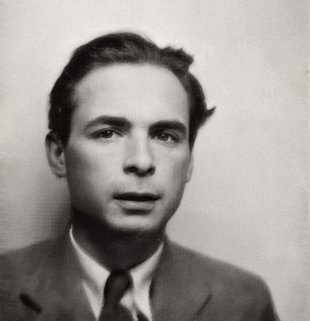
Platek was in all likelihood killed on arrival.1 Nussbaum was registered as prisoner B-3594.1, 5 In 1955 he was declared legally dead, with 9 August 1944 entered as the date of death.1 That date is now known to be wrong: in 2014 researchers working in the Russian state archives in Moscow found a report from the Auschwitz prisoners' infirmary dated 20 September 1944 recording that Nussbaum had been treated for a blister on his left index finger.1, 5 He was not among the prisoners in the camp when it was liberated on 27 January 1945, and no record of his transfer to another camp is known, so he must have died between 20 September 1944 and that date.1
Meanwhile the rest of the family was destroyed in the space of a year. In August 1943 the exemption protecting the employees of Justus Nussbaum's scrap-metal firm was withdrawn, and Justus, Herta, Marianne and the elder Nussbaums were arrested in their hiding places in the Netherlands and sent to Westerbork.2 Philipp and Rahel were deported from Westerbork to Auschwitz on 8 February 1944 and murdered there.1, 2 Justus was sent to Auschwitz on 3 September 1944; Herta and Marianne were murdered there on 6 September.2 In late October Justus was transferred to Stutthof, where he died of exhaustion about two months later.1, 2
Brussels was liberated on 3 September 1944, some five weeks after the couple's deportation and about a fortnight before the last documentary trace of Nussbaum alive.1
The paintings afterwards
The recovery of the work began in 1970 with Nussbaum's cousin Auguste Moses-Nussbaum, who traced the paintings left behind in Brussels, established their ownership and arranged for an estate of more than a hundred paintings to go to Osnabrück.4 The city built the collection up to more than two hundred works. In 1994 the Lower Saxony Savings Banks Foundation bought it and funded a new building; in 1995 Daniel Libeskind won the competition to design it against 300 other entries, and the Felix Nussbaum House opened on 16 July 1998.4 The museum also holds the largest collection of Felka Platek's surviving work — two oil paintings and 28 gouaches — about whom, and about whose life, comparatively little is known.4 An online catalogue of Nussbaum's paintings, graphic work and occasional pieces from 1919 to 1944 has been available since 2006; a revised version was due to be published in 2026.4
Sources
- "Felix Nussbaum," Wikipedia. https://en.wikipedia.org/wiki/Felix_Nussbaum
- Yehudit Shendar (Senior Curator), "Felix Nussbaum (1904–1944)," online exhibition, Yad Vashem. https://www.yadvashem.org/yv/en/exhibitions/nussbaum/about_nussbaum.asp
- "Felix Nussbaum," Künste im Exil / Arts in Exile, Deutsche Nationalbibliothek. https://kuenste-im-exil.de/KIE/Content/EN/Persons/nussbaum-felix-en.html
- "Sammlung Felix Nussbaum" (permanent exhibition, Felix Nussbaum House), Museumsquartier Osnabrück. https://www.museumsquartier-osnabrueck.de/ausstellung/sammlung-felix-nussbaum/
- "Felix Nussbaum," artist biography, Zentrum für verfolgte Künste, Solingen. https://www.verfolgte-kuenste.com/en/kunstler-innen/felix-nussbaum
- "Who was Felix Nussbaum?," The Brussels Times. https://www.brusselstimes.com/30951/who-was-felix-nussbaum
- "Mechelen," Holocaust Encyclopedia, United States Holocaust Memorial Museum. https://encyclopedia.ushmm.org/content/en/article/mechelen
- "Last train to Auschwitz," Liberation Route Europe. https://www.liberationroute.com/en/pois/1179/last-train-to-auschwitz
Further reading
- Eva Bergner, Felix Nussbaum. Verfemte Kunst – Exilkunst – Widerstandskunst. Die wichtigsten 100 Werke (Bramsche: Rasch Verlag, 1990).
- Peter Junk and Wendelin Zimmer, Felix Nussbaum. Leben und Werk (Cologne: DuMont, 1982).
- Ludwig Zerull, Felix Nussbaum (Hanover: Verlag Th. Schäfer, 1998).
- Felix Nussbaum: Art Defamed; Art in Exile; Art in Resistance (the English-language edition of the Junk and Zimmer biography, cited in source 1 for the identification of the music in Triumph of Death).
(All web sources accessed 20 August 2026.)
The narrative above follows the Osnabrück museum's account (source 4) for the readings of individual paintings, since it is the collection that holds them and its curators have published the fullest interpretation. Where that account can be checked against Yad Vashem (2), Künste im Exil (3) and the Zentrum für verfolgte Künste (5), the substance agrees. Several discrepancies between the sources should be flagged rather than smoothed over:
- Date of arrest. Sources 3, 4, 5 and 6 all give 20 June 1944. Sources 1 and 2 give July 1944 (source 1 says the couple were found in an attic "in July"; source 2 gives 20 July). The June date is used here because three independent German institutional sources agree on it and because it is consistent with the six-week interval before the 31 July transport.
- Date of deportation and arrival. Sources 3 and 4 give deportation on 31 July 1944; sources 1 and 5 give arrival at Auschwitz on 2 August. These are compatible: the last transport from Mechelen left on 31 July and took two days (7, 8). Source 2's "later that month" is vaguer but not inconsistent.
- Number of transports from Mechelen. Source 4 describes transport XXVI as the last of 26 deportation trains from Belgium; the USHMM (7) counts 28 trains in total, which includes the transports of Roma. Both figures are given as published.
- Invasion of Belgium. Source 4 dates the German invasion to 8 May 1940 and Nussbaum's arrest to two days later. The invasion took place on 10 May, and source 6 dates the arrest to that day. The 8 May date appears to be an error in source 4.
- Liberation of Brussels. Sources 1 and 2 give 3 September 1944, which is correct; source 4 gives 6 September.
- Arrival in Rome. Source 4 dates his departure for Italy to October 1932; source 1 places him at the academy in Rome in 1933. Both can be true — he arrived in 1932 and lost the scholarship in 1933 — and source 2's account of the Goebbels visit in April 1933 supports this sequence.
- Date of death. No source gives a date. The legal date of 9 August 1944, fixed in 1955, is contradicted by the infirmary record of 20 September 1944 found in Moscow in 2014, which sources 1, 5 and 6 all cite. Sources 1 and 3 conclude that he died between 20 September 1944 and the liberation of Auschwitz on 27 January 1945. This article follows that conclusion.
- The Damned and the coffin numbers. The claim that the numbers 25367 and 25368 correspond closely to the number of Jews deported from Belgium comes from source 4. It is worth noting that the USHMM's figure of 25,257 (7) is a later and more precise count than anything available in Brussels in 1944; the correspondence is close, but the reasoning behind Nussbaum's choice of figure is the museum's inference, not a documented statement by the artist.
- Whether Nussbaum wore the star. Source 4 states in passing that he never wore it. As someone living illegally without papers, he had every reason not to; the statement is plausible but rests on a single source.
The Bertolt Brecht quotation on the word "emigrants", used by Yad Vashem to frame its account of the Nussbaum family, is Brecht's own and describes his exile in Scandinavia, not Nussbaum's; it has been left out of the article above to avoid implying a connection that did not exist.
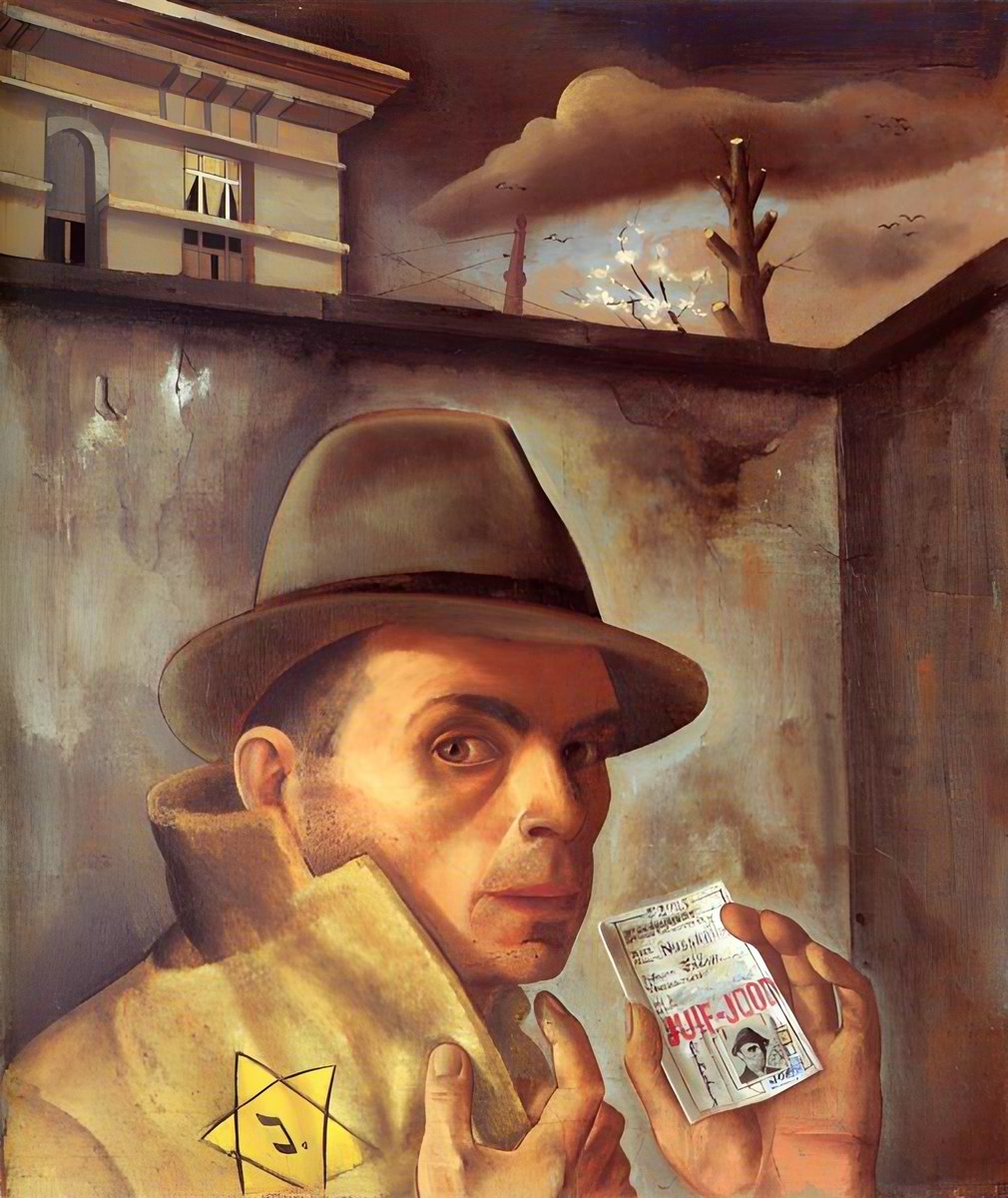
Felix-Nussbaum-Haus at Museumsquartier Osnabrück, Loan from the Niedersächsische Sparkassenstiftung
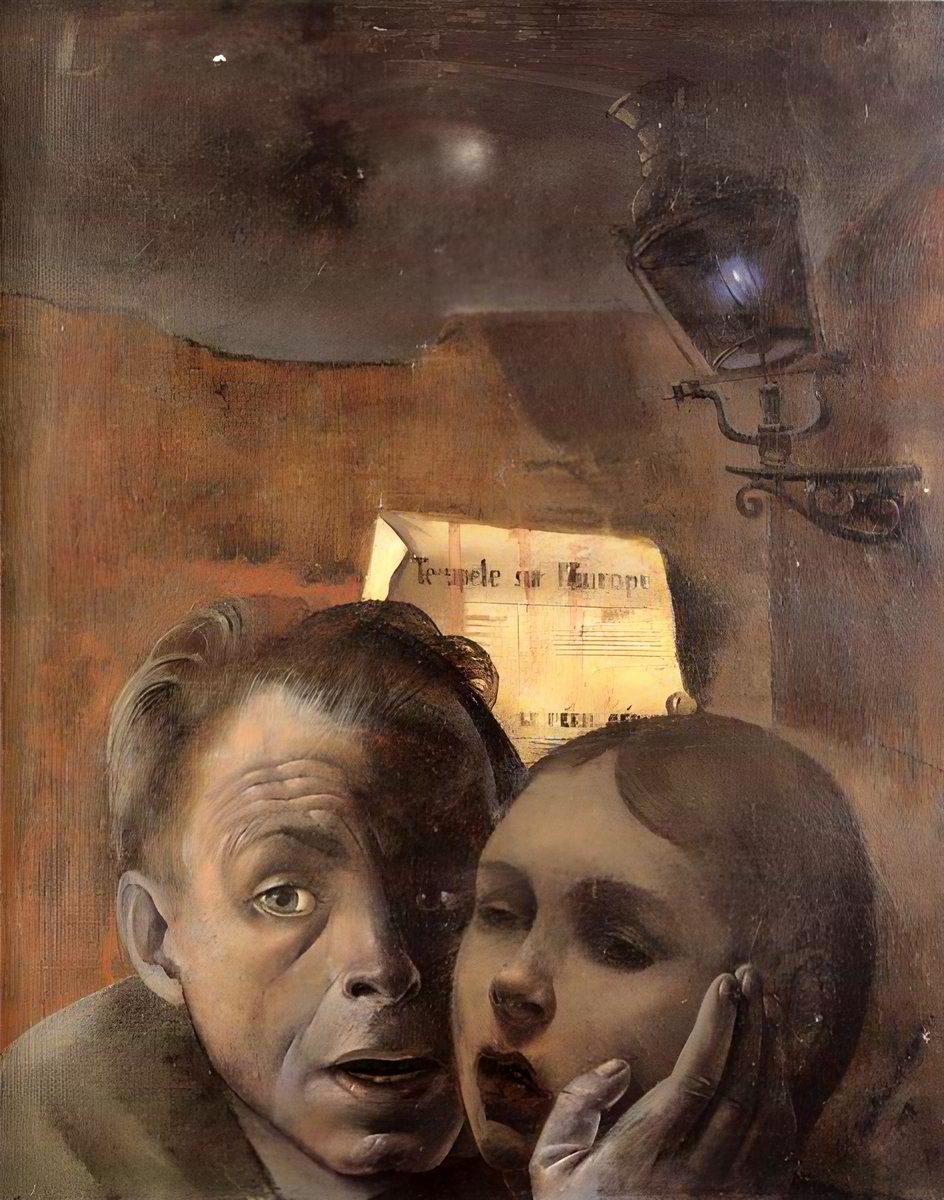
Felix-Nussbaum-Haus at Museumsquartier Osnabrück, Loan from the Niedersächsische Sparkassenstiftung.
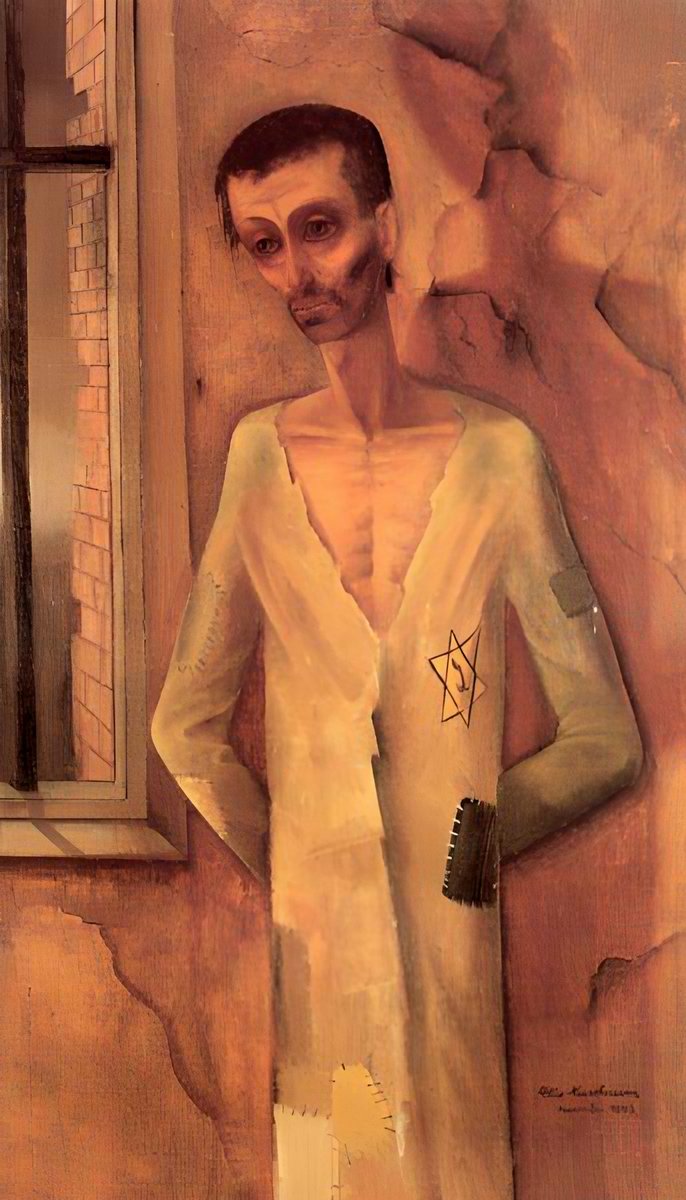
Felix-Nussbaum-Haus at Museumsquartier Osnabrück, Loan from the Niedersächsische Sparkassenstiftung.