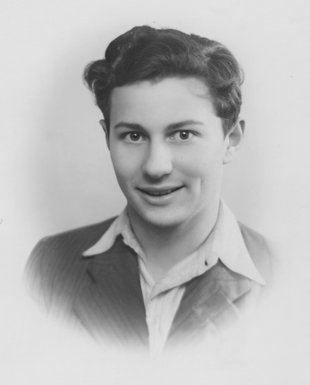
Gunther Aron
Sculptor, jeweller and Holocaust survivor
Gunther Aron was born in 1923 in Jastrow, a small market town in what was then eastern Germany, and died in Santa Fe, New Mexico, in 2014 [1][2]. His parents and one of his four siblings were murdered in the Holocaust; he and three siblings survived [2]. At fourteen, as Nazi persecution destroyed his father's business and closed off any path to higher education for Jewish children, Aron was sent to a Berlin trade school and then to the ORT vocational school, where he trained as a precision mechanic [1]. That training gave him the means to leave Germany in August 1939 with around a hundred other students, by way of a British-organised evacuation that took him briefly to Kitchener Camp in Kent and then to Leeds, where he spent the rest of the war as a toolmaker [1][6][8]. He emigrated to the United States in 1947–48 and, over the following decades in Chicago and then New Mexico, became a jeweller and sculptor known for his steel work and, in particular, for a long series of abstract Hanukkah menorahs made in memory of his sister Ruth [2][3].
Aron's father, Alwin Aron, ran a dry goods store on Berliner Strasse in Jastrow; the building belonged to his mother, Amalie, whose father, Joseph Neuman, had made his money trading in the American West in the 1840s before returning to Germany [Aron, Recollections]. Amalie's family came from Thorn, which became part of Poland after the First World War; her mother moved to Jastrow after losing her property there. Alwin and Amalie had five children: Erwin (born 1909), Ruth (born 1911), Edith (born 1913), Lissy (born 1920) and Gunther (born 1923) [Aron, Recollections][2].
Ruth had contracted polio during the First World War and never walked again, despite years of medical treatment her mother arranged in Berlin, Danzig, Göttingen and Rotterdam. She was murdered in the Holocaust along with her parents [Aron, Recollections][2]. Erwin studied chemistry at the University of Breslau and later emigrated to the United States, dying in New Jersey in 1988. Edith and her husband Herbert Haase fled to Shanghai in 1938 after Herbert was briefly held in a concentration camp during Kristallnacht; they later settled in Chicago. Lissy was stranded in the Netherlands at the outbreak of war and spent the occupation hiding from the Germans with the help of the Dutch underground, later settling near Denver, Colorado [Aron, Recollections].
After the Nazis came to power in 1933, Alwin Aron's business declined quickly: customers, particularly farmers who bought on credit, stopped paying their debts, and Jewish shopkeepers had no effective recourse in German courts. Staff left one by one as the shop lost its customers. Gunther's mother initially resisted her husband's wish to emigrate, arguing that the children needed to be educated first, but by 1937 she had concluded that the only realistic form of education left to a Jewish child in Germany was a trade [Aron, Recollections].
She arranged for Gunther to attend a newly established trade school in Berlin, funded by the Reichsvertretung der Juden in Deutschland (the national representative body of German Jews). He lived at a hostel for boys from outside Berlin at Rosenthaler Strasse 26, run by Herr and Frau Schoenfeld, and studied technical drawing, mathematics and geometry alongside practical bench work, machine operation and welding under a group of instructors that included Herr Ledermann, a dismissed engineer from the firm Ludwig Loewe, and Meister Schoenfeld, a mining-accident amputee who taught welding. The school prepared its students, in Aron's words, "for an uncertain future" [Aron, Recollections].
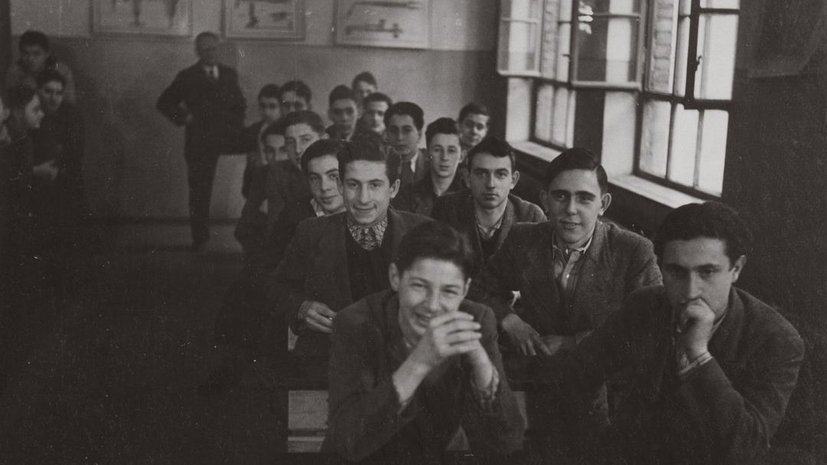
Transfer to ORT and the escape from Germany
After two years at the trade school, Aron transferred in the late spring of 1939 to the Berlin ORT school, joining its precision-mechanics ("Feinmechaniker") department under Meister Adler and his assistant Max Abraham [Aron, Recollections]. The Berlin ORT school had opened in April 1937 to train Jewish boys excluded from state education, and by 1938 had over 200 students; ownership of its buildings and equipment was held by British ORT, which gave the school some protection from Nazi interference, including during Kristallnacht [8][9].
As war approached in the summer of 1939, British ORT arranged for the school to be evacuated to England. On 29 August 1939, around 106 students and seven teachers left Berlin by train, crossing into the Netherlands and travelling on to England [1][8][9]. Aron recalled the sudden order to pack, the shortage of money for the journey (resolved at short notice by the school's director, Werner Simon), and a crowded train from Berlin's Charlottenburg station to Cologne, where he mailed a postcard home. After a tense wait at the Dutch border, the train crossed into the Netherlands: "We were free," he wrote [Aron, Recollections].
On arrival in Britain, the group was sent to Kitchener Camp, a transit camp for Jewish refugees near Sandwich in Kent, while a permanent home for the school was prepared in Leeds [6][8]. Aron's own account does not name the camp, but Home Office alien registration records place him there directly: he arrived in Britain as a refugee in August 1939, was issued Police Registration Certificate No. 768201, and was classified for a period as a "male enemy alien" at what the record calls Richborough Camp, Sandwich. A tribunal on 19 October 1939 exempted him from internment under category "C" and noted that he had declined repatriation to Germany [5].
After around three months at Kitchener Camp, the school's students moved to Leeds in December 1939, where a new ORT school and hostels had been built in the Chapeltown Road area [7][8]. Aron described the following eight years as spent "living in the north of England"; a separate account of his life specifies that he attended night classes at Leeds Art School during this period [1][3].
During the war, Aron worked as a toolmaker in a small toolroom that supplied jigs, dies and fixtures to munitions and aircraft factories [1]. This drew directly on the training he had received in Berlin. Other sources describe this period simply as work "in a munitions plant" [11][12], but the fuller detail in his own account is of specialised precision toolmaking rather than factory-floor production work.
At the end of December 1947, Aron sailed for the United States on the Queen Elizabeth, joining his brother Erwin and sisters Edith and Lissy, who were already living there [Aron, Recollections]. He settled in Chicago, where he lived for about twenty years, earning a living making industrial models for electronics companies while training as an artist at the Art Institute of Chicago and the Institute of Design, an offshoot of the Bauhaus founded by László Moholy-Nagy [2][3][11].
Aron began making jewellery in the early 1950s. In 1953, exhibiting for the first time at Chicago's Old Town Art Fair, he met Geraldine (Geri) Nelson, who had come to the fair with her cousin to buy jewellery for a gift shop; they married three years later, in 1956, and remained married until his death, a period of more than fifty years [Aron, Recollections][2][10]. According to one account, his menorah-making began when Geri wanted new candlesticks and he offered to make them himself, gradually working more candle holders into a single sculptural piece until he produced his first menorah [11]. From the late 1950s he worked almost exclusively in sculpture and Jewish ceremonial objects, developing a technique described as "direct modeling in steel" and an interest in creating a sense of motion and mass through line and plane [3]. During the 1960s this work became closely tied to the memory of his sister Ruth, who had been killed at 28; the abstract menorahs he made from this period on were made explicitly in her honour [2].
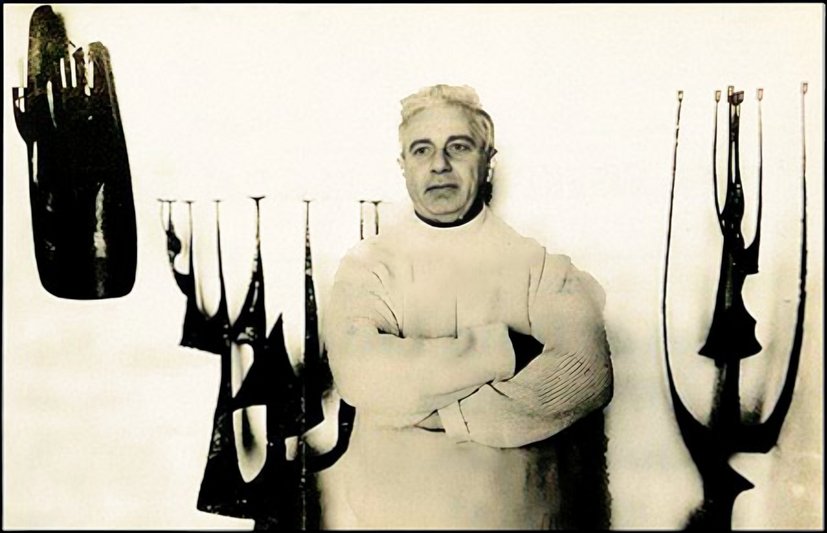
Aron continued to exhibit at the Old Town Art Fair for about twenty years, showing jewellery first and later sculpture and menorahs [Aron, Recollections].
In 1968 Aron and Geri bought an old four-room adobe schoolhouse in the foothills of the Sangre de Cristo mountains near Lamy, New Mexico, about fifteen miles southeast of Santa Fe, moving there permanently in 1973 [Aron, Recollections][2][10]. He converted one classroom into his studio and used a long hallway to display and store his sculpture, while renting out a second classroom as a studio apartment to supplement their income [Aron, Recollections]. He continued to work there until hand tremors made welding, which was central to his technique, increasingly difficult and eventually impossible; combined with the demands of maintaining an isolated property with its own water, sewage and heating systems, this led the couple to sell the schoolhouse and move into Santa Fe around 1987–88 [Aron, Recollections][10].
Aron's menorahs and sculpture were shown and collected internationally, including at the Jewish Museum in New York, the Skirball Museum in Los Angeles, the Jüdisches Museum Berlin and the Joods Historisch Museum in Amsterdam, as well as at the Art Institute of Chicago, the Museum of New Mexico and the Jewish Community Center of Dallas [2][3]. In New Mexico his work is held by Temple Beth Shalom and the Capitol Art Collection in Santa Fe, and by the Holocaust Museum in Albuquerque [2]. He also donated a six-foot steel menorah of his own making to a Holocaust museum in New Mexico, and spoke publicly about the significance of lighting it: "It would have pleased my parents to see me perform this public lighting," and "I still remember the blessings from my childhood" [12].
Describing his working method, Aron said he relied on "a strict, religious adherence to a dialogue between artist and work," scrutinising a piece as it developed to work out what changes were needed to stay true to its character and to his own aesthetic sense [3].
Late in life, Aron spoke about the relationship between his art and his early experience of Nazi persecution: "I've spent the last 73 years trying to forget that the Holocaust ever happened. Creating menorahs in memory of my sister was a constant reminder of that horrific time" [2]. He died in Santa Fe on 27 August 2014, aged 91 [10].
Art and the Holocaust, August 2026
Sources
- Gunther Aron, "Recollections," in Transcripts of Holocaust Survivor Interviews, page 8, © Jim Terr / Blue Canyon Productions, 1999–2000, transcript dated 1 November 1999. www.bluecanyonproductions.com/holo_transcript08.html
- Ana Pacheco, "Remnants of the Holocaust Heal with Abstract Menorahs," History in Santa Fe, 1 September 2020. historyinsantafe.com/remnants-of-the-holocaust-heal-with-abstract-menorahs/
- "Aron Hanukkah Menorah," New Mexico Capitol Art Collection, updated 18 May 2025. www.nmcapitolart.net/aron-hanukkah-menorah-18/
- World ORT, internal communication to the ORT Archive, August 2026 (unpublished; describes Gunther Aron's donation of a menorah and his connection to ORT Berlin).
- "Gunter Aron," Kitchener Camp – Refugees to Britain in 1939, List of Names, citing The National Archives, Home Office: Aliens Department, Internees Index, 1939–1947. kitchenercamp.co.uk/list-of-names/gunter-aron/
- "Berlin ORT," Kitchener Camp – Refugees to Britain in 1939, Research. kitchenercamp.co.uk/research/berlin-ort/
- "The ORT," Kitchener Camp – Refugees to Britain in 1939. kitchenercamp.co.uk/the-ort/
- "The Berlin-Leeds ORT School, 1937–1943," World ORT Archive. ortarchive.ort.org/stories/from-berlin-to-leeds
- "The Last Jewish School in Berlin," World ORT News. ort.org/news/the-last-jewish-school-in-berlin/
- "Gunther Aron," obituary, Legacy.com. www.legacy.com/obituaries/name/gunther-aron-obituary
- "Welcome to Chucksville and Gunther Aron, Menorah Maker!," chucksville.com. chucksville.com/menorahMaker.html
"With Santa Fe Watching, Holocaust Survivor Lights Towering Chanukah Menorah," Chabad.org News. www.chabad.org/news/article_cdo/aid/1378237/jewish/Holocaust-Survivor-Lights-Towering-Chanukah-Menorah.htm